
A spring return hydraulic cylinder is a single acting cylinder that uses an internal compression spring to retract the piston rod automatically when hydraulic pressure is released. Because the spring — not gravity — drives retraction, a spring return hydraulic cylinder operates reliably in any mounting orientation: horizontal, vertical, or inverted. This makes it the standard choice for clamping fixtures, valve actuators, and any application where the mounting geometry prevents gravity-assisted return.

How a Spring Return Hydraulic Cylinder Works
The operating principle of a spring return hydraulic cylinder has two phases. In the extension phase, hydraulic pressure enters the cap-end port and acts on the piston face. The force produced — Pressure × Bore Area — overcomes the spring pre-load and any external resistance, pushing the rod outward. The spring compresses as the rod extends, storing energy proportional to the compression distance and the spring rate. In the retraction phase, when the control valve shifts to neutral or tank, hydraulic pressure is removed from the cap end. The compressed spring releases its stored energy, pushing the piston — and the rod — back to the retracted position, displacing oil out through the cap-end port to the reservoir.
The spring is housed inside the barrel, typically between the cap end and the rear face of the piston. In long-stroke spring return cylinders, the spring may be housed in a separate spring chamber behind the cap end to avoid limiting the stroke. The spring compound is selected to resist corrosion from hydraulic oil contact — chrome vanadium or carbon steel with zinc phosphate treatment are standard.
Net Extension Force: The Spring Pre-Load Deduction
The net extension force of a spring return hydraulic cylinder is the gross hydraulic force minus the spring pre-load force. At any point in the stroke, the spring is compressed by a certain amount and is pushing back against the piston. This spring reaction force reduces the net force available to the external load.
Spring Force = Spring Rate (N/mm) × Compression Distance (mm)
Example: 63 mm bore at 20 MPa → Gross Force = 62,400 N
Spring rate 15 N/mm, 80 mm compression → Spring Force = 1,200 N
Net Extension Force = 62,400 − 1,200 = 61,200 N
For most standard spring return applications, the spring pre-load deduction is less than 3–5% of the gross hydraulic force — negligible for most practical purposes. However, for high-rate springs in short-stroke cylinders where the spring is heavily compressed at full extension, the deduction becomes significant and must be calculated explicitly.
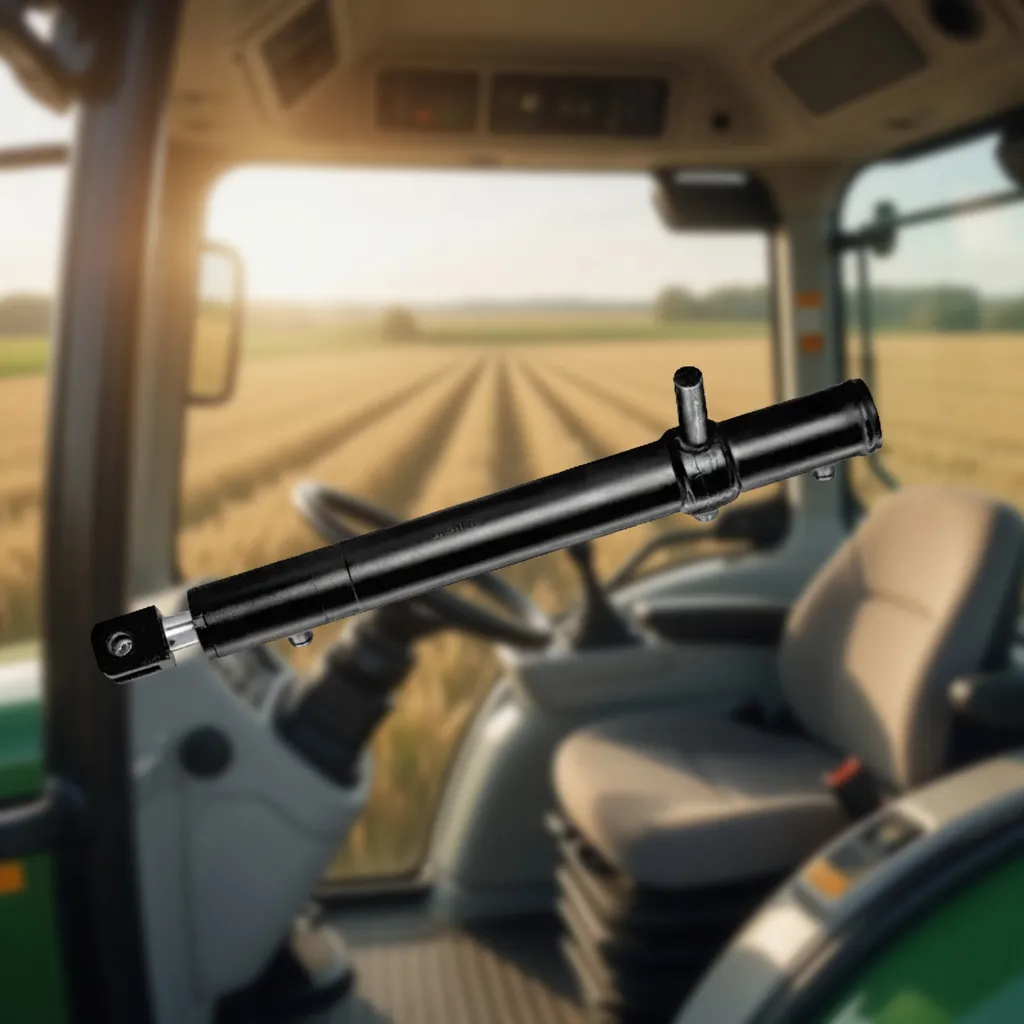
Typical Applications of Spring Return Hydraulic Cylinders
Workpiece Clamping Fixtures
The cylinder clamps under hydraulic pressure and springs open when pressure is released. This provides a built-in fail-safe: hydraulic failure opens the clamp rather than leaving the workpiece locked under unpredictable force. Standard in machining centres and welding jigs.
Valve Actuators
Process control valves on pipelines use spring return actuators that drive the valve to the fail-safe position (open or closed) on loss of hydraulic or pneumatic pressure. Essential for emergency shutdown systems.
Horizontal Installations
Where gravity cannot assist retraction — conveyor diverter gates, horizontal pressing operations, and sorting mechanisms — the spring provides consistent return force at any angle.
Agricultural Implement Folding
Folding mechanisms on wide cultivators and sprayer booms use spring return single acting cylinders that fold under spring force and unfold under hydraulic pressure, with spring force ensuring reliable fold-back in the transport position.
Spring Return vs Gravity Return: When to Choose Each
| Factor | Spring Return | Gravity Return |
|---|---|---|
| Mounting orientation | Any — horizontal, inverted, angled | Rod must point upward for reliable return |
| Retraction reliability on pressure loss | Reliable — spring always returns the rod | Only if gravity assists the return direction |
| Net extension force | Reduced by spring pre-load | Full hydraulic force available |
| Cylinder body length | Longer — spring occupies internal space | Shorter — no spring inside barrel |
| Weight | Heavier — spring adds mass | Lighter |
| Typical applications | Clamps, valves, horizontal actuators | Lifting, tipping, pressing with tool weight return |
Spring Fatigue: The Wear Component That Is Often Overlooked
The return spring in a spring return hydraulic cylinder is a fatigue-loaded component — it compresses and extends on every stroke cycle. Spring wire fatigue causes a gradual reduction in spring rate over time, manifesting as progressively slower retraction or incomplete return to the fully retracted position. At overhaul, inspect the spring for: permanent set (measure free length against the original specification), corrosion pitting on wire surfaces, and visible cracking at coil ends. Replace the spring if free length has reduced by more than 5% of the original specification. Contact Ever-Power for replacement springs matched to specific cylinder models and stroke requirements.
Request a Free Specification Review
Send your application details to [email protected] or call +86-571-88220653. Our engineers respond within 24 hours.