
Hydraulic cylinder seal material selection is the specification decision with the greatest impact on seal service life — greater than oil cleanliness, greater than installation technique, and far greater than brand choice. The same hydraulic cylinder seal installed in a system 20°C outside its compound’s rated temperature window can fail within days. This guide covers every major seal compound for hydraulic cylinders, the exact temperature ranges each handles reliably, and how to match seal material to your application’s real operating conditions.
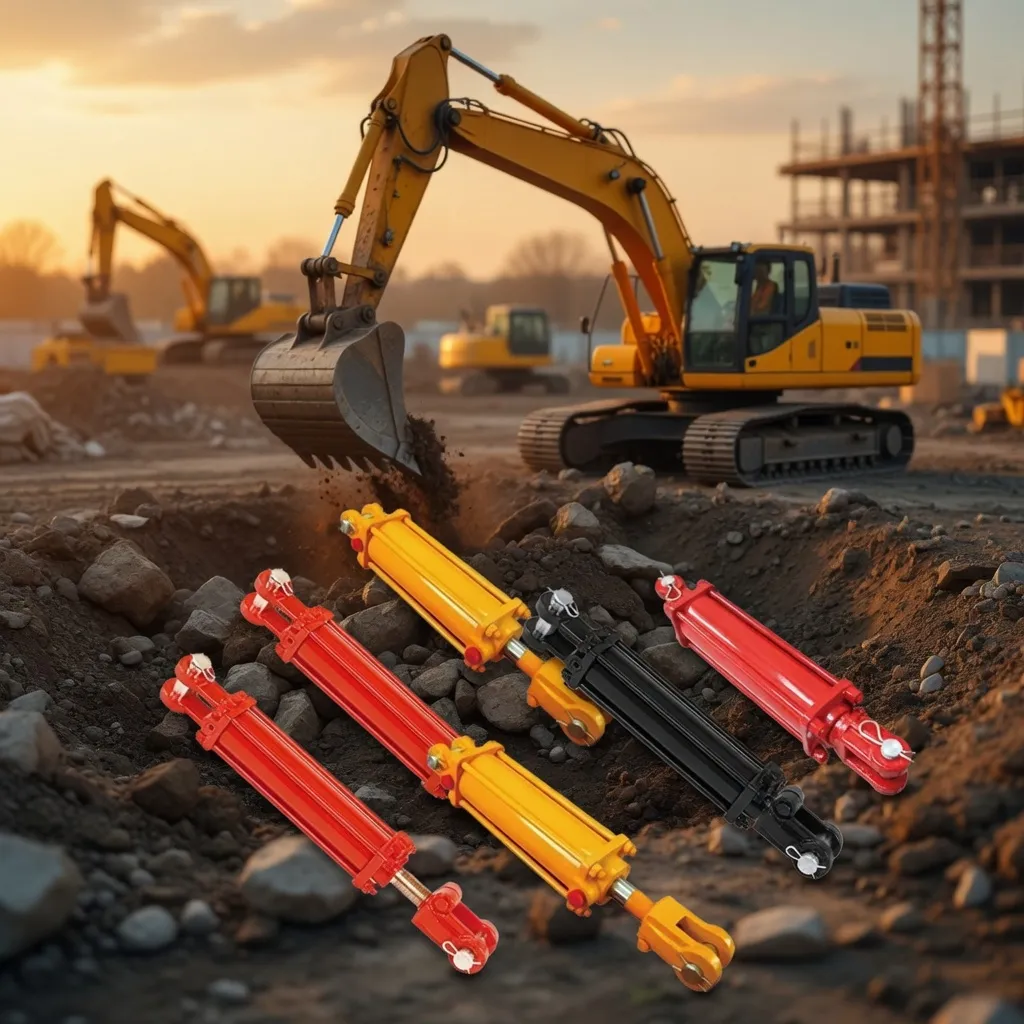
The Four Main Hydraulic Cylinder Seal Compounds
NBR — Nitrile Butadiene Rubber
Temperature range: -20°C to +80°C. The traditional standard for hydraulic seals. Good mechanical strength and abrasion resistance. Compatible with mineral hydraulic oil. Low cost. Not suitable for outdoor machinery with cold-start below -20°C or sustained high-temperature duty.
PU — Polyurethane
Temperature range: -30°C to +90°C. Superior abrasion resistance versus NBR — typically 3–5× longer wear life in contaminated systems. Extends the cold end by 10°C versus NBR. The preferred default compound for agricultural, construction, and outdoor mobile machinery.
FKM — Fluoroelastomer (Viton)
Temperature range: -20°C to +200°C. Excellent chemical resistance and heat stability. The choice for high-temperature industrial applications, fire-resistant fluid systems, and chemical processing. 3–5× higher cost than NBR. Not suitable for cold climates — loses flexibility below -20°C.
PTFE-Composite
Temperature range: -60°C to +200°C. Widest temperature range of all seal compounds. Lowest friction coefficient — important for precision position control. Excellent chemical resistance. Requires tighter rod surface finish (Ra 0.1–0.2 μm). No elastic recovery — groove geometry is critical.
Temperature Range Comparison: Which Compound Covers Your Application
| Application | Typical Temperature Range | Recommended Compound |
|---|---|---|
| Indoor industrial press — climate controlled | -5°C to +60°C | NBR — cost-effective for this range |
| Agricultural machinery — UK/Europe outdoor | -25°C to +75°C | PU — covers cold start and summer peak |
| Agricultural machinery — tropical/subtropical | +10°C to +85°C | PU or NBR — confirm peak oil temperature |
| Construction machinery — cold climate | -35°C to +70°C | PU — NBR too hard below -20°C |
| Offshore marine — North Sea | -15°C to +60°C (ambient) | PU + stainless rod — salt corrosion priority |
| Steel mill hydraulics — furnace proximity | +20°C to +120°C | FKM — NBR and PU both fail above 90°C |
| Chemical processing — solvent exposure | -10°C to +150°C | FKM or PTFE-composite |
| Subsea — deep cold water | -5°C to +60°C (oil temp) | PTFE or low-temp FKM — pressure rating priority |
Beyond Temperature: Chemical Compatibility
Temperature range is the primary selection criterion, but chemical compatibility must also be confirmed. The hydraulic fluid type affects seal compatibility independently of temperature.
| Fluid Type | NBR | PU | FKM | PTFE |
|---|---|---|---|---|
| Mineral hydraulic oil (HLP, HM) | ✅ Compatible | ✅ Compatible | ✅ Compatible | ✅ Compatible |
| Biodegradable vegetable oil (HETG) | ✅ Compatible | ✅ Compatible | ✅ Compatible | ✅ Compatible |
| Biodegradable synthetic ester (HEES) | ✅ Compatible | ✅ Compatible | ✅ Compatible | ✅ Compatible |
| Polyglycol (HEPG) | ⚠️ May swell | ✅ Compatible | ⚠️ Check grade | ✅ Compatible |
| Water-glycol fire resistant (HFC) | ⚠️ Limited | ⚠️ Check grade | ✅ Compatible | ✅ Compatible |
| Phosphate ester fire resistant (HFD-R) | ❌ Not compatible | ❌ Not compatible | ✅ Compatible | ✅ Compatible |
For applications with non-standard fluid chemistry, combined temperature-chemical exposure, or unusual operating conditions — such as repeated high-pressure washdown, fertiliser spray contact, or temperature cycling — submit the full application description to the Ever-Power engineering team for a compound recommendation before ordering. Specifying the wrong compound costs more in repeated seal replacement than the price difference between compounds.
Request a Free Specification Review
Send your application details to [email protected] or call +86-571-88220653. Our engineers respond within 24 hours.