
A hydraulic cylinder that extends sluggishly or noticeably slower than its rated speed is signalling a problem somewhere in the system — rarely the cylinder itself. Extension speed is determined by the flow rate reaching the cylinder and the bore area. When speed drops, either flow has reduced or something is diverting it before it reaches the cylinder. Systematic diagnosis of the flow path from pump to cylinder identifies the cause in most cases within 30 minutes.
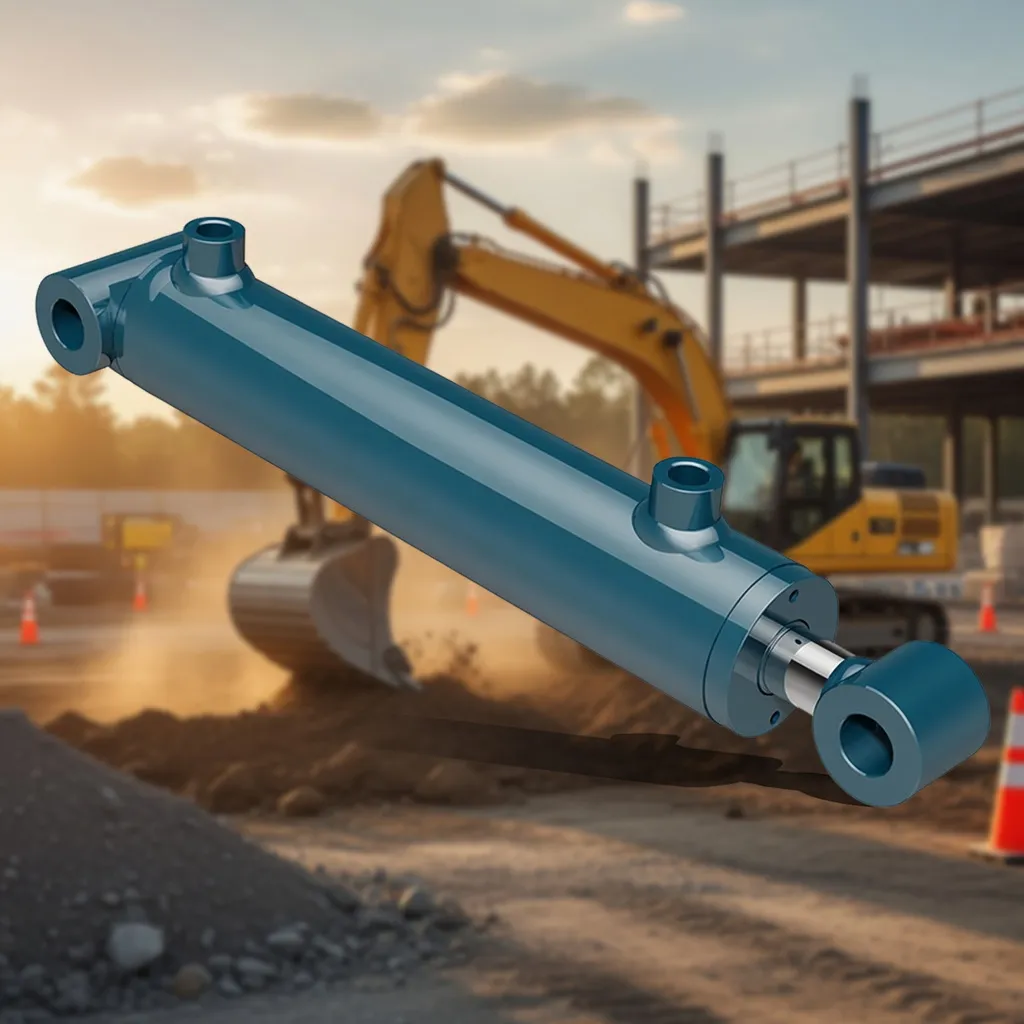
Understanding Extension Speed: The Flow and Bore Relationship
Extension speed (mm/s) = Pump Flow (L/min) × 1000 ÷ 60 ÷ Bore Area (cm²). This formula is exact and linear. If a 63 mm bore cylinder operating at a 20 L/min pump flow is extending at 106 mm/s and the speed drops to 53 mm/s, exactly half the pump’s flow is being diverted away from the cylinder or lost to internal leakage. The diagnostic task is to identify where that flow is going.
The starting point for any slow cylinder diagnosis is to measure actual pump output flow — not to assume it matches the rated specification. Pump wear reduces volumetric efficiency progressively; a pump that was delivering 20 L/min when new may deliver only 14 L/min after several thousand hours at high pressure. This 30% flow reduction produces exactly the slow extension symptom, and no amount of valve adjustment or cylinder replacement will fix it.
Cause 1 — Insufficient Pump Output Flow
Hydraulic pump volumetric efficiency decreases with wear. Internal leakage across pump elements — gear tooth clearances in gear pumps, vane tip clearances in vane pumps, piston bore clearances in piston pumps — allows pressurised oil to recirculate internally rather than being delivered to the circuit. The result is reduced output flow at the same shaft speed. A pump that is 20% worn delivers 20% less flow, and the cylinder extends 20% more slowly.
Test pump output by measuring flow at the pressure relief valve setting with a calibrated flow meter in the pressure line. Compare to the pump’s rated flow at the operating speed and pressure. If output is more than 10% below the rated flow, pump rebuild or replacement is the most cost-effective fix — circuit adjustments cannot compensate for a worn pump delivering less than its rated output.
Cause 2 — Flow Control Valve Set Too Restrictive
Flow control valves in the extension circuit limit flow to the cylinder as a deliberate speed-reduction measure. If the valve has been partially closed — by accident, during an unrelated adjustment, or by gradual spool drift — the cylinder extension speed drops proportionally. Check every flow control valve in the extension path. Ensure each is set to the correct position. A flow control valve stuck in a partially closed position due to contamination requires cleaning or replacement.
Cause 3 — Relief Valve Set Too Low
If the system relief valve is set at or below the pressure required to move the load, the pump pressure rises to the relief setting and then dumps flow to tank rather than moving the cylinder. The cylinder extends very slowly — at the trickle rate of whatever flow slips past the relief valve — or stalls completely. This is a common post-maintenance issue when a relief valve is replaced and set at its factory default rather than the system-specific setting.
The correct relief valve setting is 10–15% above the maximum load pressure. Measure load pressure with the cylinder fully loaded and stalled — the gauge reading is the required minimum relief valve setting. Set the valve 10–15% above this value to provide a pressure margin for dynamic load peaks.
Cause 4 — Restricted Line or Blocked Port
| Restriction Source | Diagnostic Indicator | Fix |
|---|---|---|
| Kinked or collapsed hose | Slow extension specific to one cylinder; others normal | Inspect and replace hose |
| Partially closed isolation valve | Sudden onset of slow extension after maintenance | Check and fully open all isolation valves in circuit |
| Blocked inlet port screen or filter | Slow extension worsening over time; cavitation noise | Replace pressure filter element; clean port screen |
| Undersized line bore for flow rate | Slow extension at high flow demand; normal at low speed | Upsize hydraulic line to match flow requirement |
| Fitting sealant partially blocking port | Slow on a cylinder recently re-plumbed | Inspect port with bore scope; clear obstruction |
Cause 5 — Piston Seal Internal Bypass
A failed piston seal allows oil to bypass across the piston from the high-pressure cap-end chamber to the low-pressure rod-end chamber. This oil is then returned to the reservoir rather than contributing to extension. The result is that the cylinder extends slowly even when pump output is normal — because a fraction of the delivered flow is bypassing the piston rather than pushing it.
Piston bypass is confirmed by the line-disconnection and stall test: disconnect the rod-end return line from the cylinder, plug the cylinder rod port, and extend the cylinder slowly. If significant oil flows from the disconnected rod-end port on the cylinder, the piston seal is bypassing. The cylinder must be rebuilt with a new piston seal kit.
Cause 6 — Air Entrainment in the Hydraulic Oil
Air dissolved or entrained in hydraulic oil reduces the effective bulk modulus of the fluid, meaning the pump must compress the air before building pressure to move the cylinder. The symptom is a slow, spongy extension that is inconsistent from cycle to cycle. Check the reservoir oil level — a low level allows the suction line to draw air. Check the suction line for leaks at fittings. Bleed the system and top up the reservoir with the correct grade of hydraulic oil. If aeration persists, contact our engineering team for circuit diagnosis support.
Request a Free Specification Review
Send your application details to [email protected] or call +86-571-88220653. Our engineers respond within 24 hours.